
Concrete Challenges on Parking Decks, Ramps, and Sloped Industrial Floors
This article explains the challenges of placing concrete on parking decks, ramps, and sloped industrial floors. It is written for contractors and construction professionals who manage complex slab pours requiring precise elevation, slope control, and drainage performance. The content covers common risks, finishing challenges, and how laser screed technology and experienced operators help improve accuracy and long-term durability in sloped concrete applications.
Not all concrete slabs are created equal.
A flat warehouse floor has its own demands, but when a concrete pour includes parking decks, ramps, drainage systems, or sloped industrial surfaces, the level of complexity increases quickly. These are not just larger pours. They are precision-driven placements where small mistakes in elevation or pitch can create long-term performance problems.
For contractors, these projects often come with higher stakes, tighter tolerances, and less room for error.
Parking structures, in particular, highlight how critical slope control really is. Every section of the slab has a purpose. Water needs to move in a controlled direction, vehicles need safe and predictable transitions, and the finished surface must meet strict design and safety requirements.
When that balance is off, even slightly, the consequences can show up immediately.
Why Sloped and Elevated Slabs Are More Complex
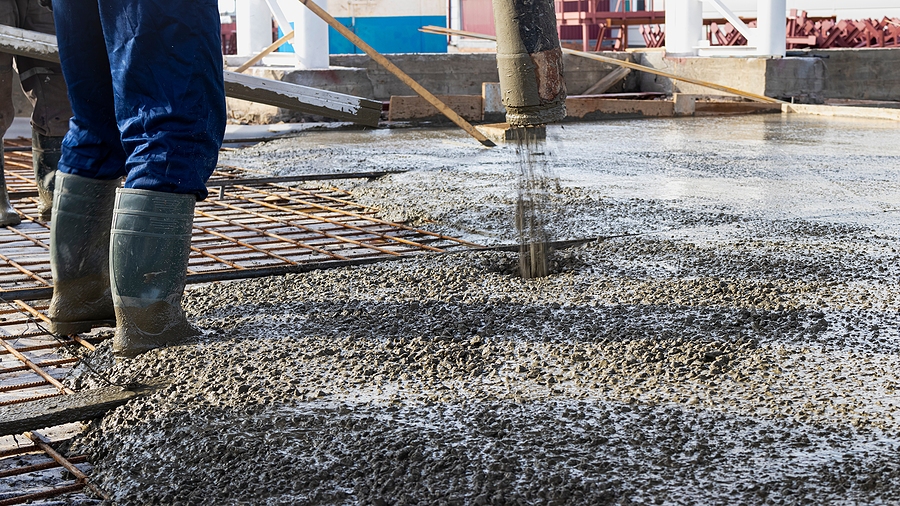
Unlike flatwork, sloped concrete introduces constant change across the surface. Instead of maintaining a single elevation, crews are managing continuous transitions that may include:
- Ramps between levels
- Drainage slopes in parking decks
- Tapered transitions at entry and exit points
- Structural elevation changes in industrial facilities
Each of these elements requires precise control of both grade and pitch.
The challenge is not just setting the correct slope at the beginning. It is maintaining that slope consistently across the entire pour while accounting for real-world jobsite variables like formwork, reinforcement, skilled labor, and placement flow.
Even small deviations can compound across a large slab.
On a flat surface, a minor inconsistency may not be immediately noticeable. On a sloped surface, it can affect how water moves, how vehicles travel, and how the structure holds up over time.
The Real Risk of Improper Slope
When slope or elevation is not executed correctly, the effects are often functional rather than just cosmetic.
One of the most common issues is drainage failure.
Parking decks and ramps are designed to move water efficiently. If the slope is too shallow, uneven, or inconsistent, water can begin to collect in low areas. This leads to standing water, which creates a chain of problems including:
- Accelerated surface deterioration
- Increased risk of freeze-thaw damage in colder climates
- Slip hazards for vehicles and pedestrians
- Long-term maintenance issues for owners
In more serious cases, improper drainage can lead to compliance concerns. Parking structures have to meet specific design standards for slope and runoff management. If the finished slab does not align with those requirements, contractors may face callbacks for remediation work.
How Power Laser Screeds Improve Slope Control
Laser screed technology introduces a level of precision that is difficult to achieve consistently through manual methods.
By using a rotating laser reference system, the screed continuously adjusts the leveling head based on elevation data. This allows the machine to maintain accurate slope and grade across the slab in real time.
On projects involving parking decks, ramps, or complex drainage designs, this capability becomes especially valuable.
Instead of relying entirely on manual strike-off, the laser screed helps manage:
- Continuous slope accuracy across long runs
- Elevation transitions between slab sections
- Consistent grade over variable surfaces
- Tight tolerance requirements for flatness and pitch
The Somero S-940 Laser Screed® is designed to handle complex site conditions, including:
- Slab-on-deck applications
- Chaired mesh and chaired rebar
- Embedded systems like heat tubes
- Variable slope conditions
This versatility allows contractors to maintain precision even when the slab includes structural or mechanical constraints that complicate placement.
The Importance of Experienced Operators
Even with advanced equipment, operator experience still plays a major role in project success.
Sloped and transition-heavy concrete slabs require more than just machine operation. They require an understanding of how concrete behaves during placement, how environmental conditions affect finishing, and how to adjust the workflow in real time.
An experienced operator can help ensure that:
- The machine is properly calibrated for site conditions
- Slope requirements are accurately interpreted and executed
- Transitions between sections are handled smoothly
- Placement speed is matched to finishing workflow
This becomes especially important in parking structures, where errors are not easily hidden or corrected after the fact.
Owning a Screed Isn’t Always Practical
Not every contractor needs to own specialized equipment for sloped or complex slab work. These types of projects may come up periodically rather than continuously, making ownership a significant investment for limited use.
This is where rental solutions provide a practical advantage.
Renting a laser screed from Myles Construction includes an experienced operator and allows contractors to access advanced slope control technology without committing to the cost and maintenance of ownership.
With operator-included rentals, contractors also avoid:
- Equipment training requirements
- Maintenance responsibilities
- Storage and transportation logistics
- Long-term capital investment
Instead, you gain access to both the equipment and the expertise needed to handle complex slab conditions effectively.
This makes rentals particularly well-suited for:
- Parking deck construction
- Multi-level ramp systems
- Industrial facilities with drainage slopes
- Projects with strict flatness and pitch requirements
Building Better Sloped Slabs With Greater Control
Parking decks, ramps, and sloped industrial floors are among the most demanding types of concrete work. They require precision, consistency, and careful management of elevation changes from start to finish.
When those elements are not controlled properly, the consequences can extend far beyond the initial pour, affecting drainage, usability, compliance, and long-term durability.
Laser screed technology offers a way to reduce that risk while improving consistency across complex surfaces. By combining precision equipment with experienced operation, contractors can approach these projects with greater confidence and control.
For teams that do not need permanent ownership, rental solutions provide a flexible way to bid on and handle specialty slab jobs without adding long-term business expenses.
Having the right tools available at the right time can make all the difference. Contact Myles Construction to secure your laser screed rental today.