
Common Reasons Commercial Concrete Floors Fail Inspection
Commercial concrete contractors working on large warehouses, distribution centers, manufacturing facilities, data centers, and other industrial projects need to meet strict floor flatness, levelness, and elevation requirements. This article explains common reasons large concrete slabs fail inspection, including inconsistent elevations, reliance on manual screeding, insufficient pre-pour planning, and delayed corrections. It also explains how laser screeding with an experienced operator can help contractors improve consistency, manage labor demands, and reduce the risk of costly rework.
In a large warehouse, distribution center, manufacturing plant, data center, or other industrial facility, the finished slab has to meet more than visual expectations. Floor flatness and levelness requirements, elevation tolerances, surface quality, and project specifications all have to be satisfied before the next phase of construction can move forward.
When a floor fails inspection, the consequences can extend well beyond the concrete itself. Corrective work can add labor and equipment costs, delay other trades, disrupt the project schedule, and create problems for the contractor responsible for the pour.
Many inspection failures are not caused by one major mistake. They result from small inconsistencies during placement that become more significant across a large slab. Understanding the most common causes can help contractors plan more effectively and reduce the risk of expensive corrections.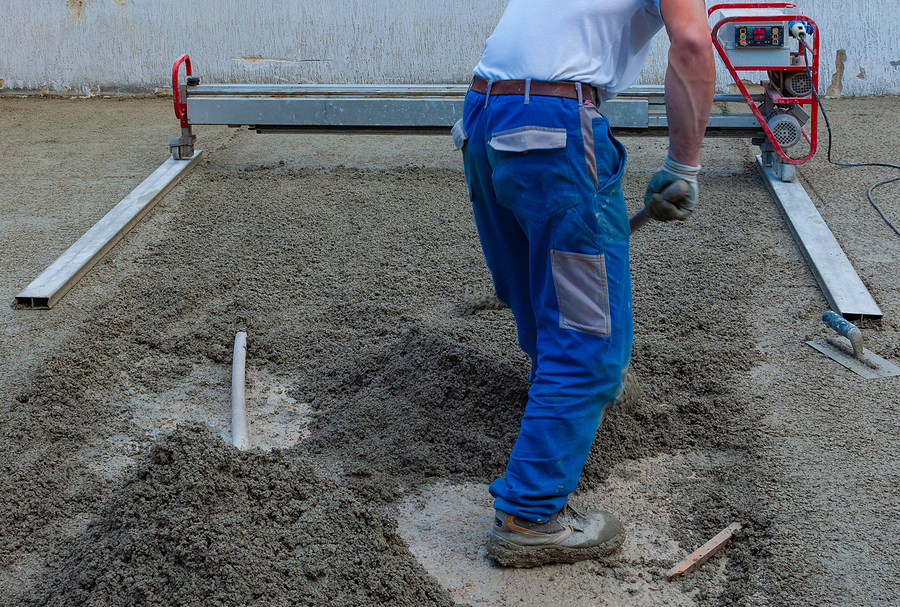
Inconsistent Slab Elevations
One of the most common reasons a commercial concrete floor fails inspection is inconsistent elevation.
Large slabs need to be placed to the specified elevation across the entire floor. When some areas are too high or too low, the finished surface may fall outside the project’s requirements.
Maintaining consistent elevations becomes increasingly difficult as slab size increases. Manual screeding requires crews to continuously strike off fresh concrete while checking and adjusting grades. The larger the placement area, the more opportunities there are for small variations to develop.
Those variations may not be obvious while the concrete is being placed. By the time the slab has cured and measurements are taken, correcting them can require grinding, leveling, or other remediation.
Accurate grade control during placement is much more efficient than trying to correct elevation problems afterward.
Relying Too Heavily on Manual Screeding
Manual screeding can be effective for many concrete applications, but large commercial slabs place significant demands on the process.
Hand screeding requires multiple workers to continuously move, strike off, and level fresh concrete across the placement area. As the pour continues, physical fatigue can affect production speed and consistency.
The problem becomes more pronounced when labor is limited.
You may start a large pour with an adequately staffed crew, only to find that maintaining the same production rate becomes increasingly difficult as the day progresses. Slower production can create inconsistencies, compress the time available for finishing, and make it harder to maintain the desired slab elevations.
When floor tolerances are strict, relying entirely on a labor-intensive process can introduce unnecessary variability.
Insufficient Planning for the Slab Conditions
Not every commercial slab presents the same challenges.
Large industrial projects may include slopes, elevation changes, congested reinforcement, embedded systems, heat tubes, or slab-on-deck construction. Each condition can affect how concrete is placed and struck off.
Using the same approach for every project can create unnecessary risk.
Equipment, crew size, placement sequence, and production methods should be considered before concrete arrives at the jobsite. A method that works well on a straightforward slab may not be appropriate for a large placement with complex elevations or other site conditions.
Pre-pour planning provides an opportunity to identify these challenges and determine how the placement process will address them.
Trying to Correct Problems Too Late
Another common problem occurs when contractors wait too long to address inconsistencies.
Fresh concrete provides an opportunity to make adjustments while placement is still underway. Once the concrete has hardened, options become more limited and expensive.
Grinding, leveling, patching, and other corrective methods require additional labor and equipment. They can also interfere with the schedule for other trades.
The best opportunity to prevent an inspection failure is during the placement itself.
That means maintaining grade control, monitoring the slab throughout the pour, and addressing inconsistencies before they become larger problems.
How Laser Screeding Can Reduce Risks
Laser screeding can help contractors create a more consistent placement process on large commercial and industrial slabs.
Laser-guided equipment is designed to maintain accurate slab elevations while reducing the amount of manual labor required for strike-off. This helps contractors maintain production across large placement areas without relying entirely on a large hand-screeding crew.
The benefit is not simply speed. Consistency is a major part of the value.
When the strike-off process produces more uniform elevations, finishing crews have a more consistent surface to work with. That can reduce the need for corrective work and help you meet demanding floor tolerance requirements.
Laser screeding can also be useful on projects where labor availability is limited. Instead of adding more workers to handle a physically demanding task, contractors can use equipment to make the existing workforce more productive.
Operator Experience Matters
Using a laser screed does not eliminate the need for experienced concrete professionals. The equipment still needs to be operated correctly and integrated into the overall placement process.
An operator-included rental provides contractors with a skilled, trained operator who understands how to use the equipment under real jobsite conditions.
That can be especially valuable on large or complex projects where slab elevations, reinforcement, deck conditions, or other factors require adjustments during placement.
Prevent Inspection Problems Before They Start
A failed concrete floor inspection can create costs that extend far beyond the original pour. Rework, additional labor, schedule delays, and disruption to downstream trades can all affect the profitability of a project.
The best way to reduce that risk is to address potential problems before and during placement. Careful pre-pour planning, realistic crew allocation, proper grade control, coordinated production, and the right equipment all contribute to a more predictable result.
For large commercial and industrial slabs, a laser screed rental with a skilled operator from Myles Construction is a much more efficient way to finish the job. Contact us today to reserve your next rental.